

Understanding PAC Through Its Safety Data Sheet (SDS)
PAC (Poly Aluminium Chloride), also known as aluminum polychloride, with the chemical formula Alₙ(OH)ₘCl₃ₙ₋ₘ, is widely used in the treatment of domestic and industrial wastewater. Let’s explore comprehensive information about this product through its Safety Data Sheet (SDS), also known as the Chemical Safety Data Sheet.
PART I: IDENTIFICATION OF THE CHEMICAL AND SUPPLIER INFORMATION
1. Chemical Identification
Item | Information |
Product | PAC Powder |
Common name | PAC Powder |
Trade name | Poly Aluminium Chloride |
CAS No. | 1327-41-9 |
UN No. | 3264 |
EC No. | 215-477-2 |
HMIS (USA) – Health Hazard | 1 |
HMIS (USA) – Flammability | 0 |
HMIS (USA) – Reactivity | 0 |
HMIS (USA) – Personal Protection | E |
2. Recommended Use and Restrictions on Use
PAC is used in raw water treatment, wastewater treatment, drinking water treatment, and industrial process applications, including the pulp and paper, oil and gas, and other industries.
3. Supplier Information
Dong A Joint Stock Company
Address: Zone 9, Phu Ninh Commune, Phu Tho Province, Vietnam
Tel: +84 210 652 3333
Email: kinhdoanh@dongachem.vn
4. Emergency Telephone Number
Dong A Joint Stock Company
Address: Zone 9, Phu Ninh Commune, Phu Tho Province, Vietnam
Tel: +84 210 652 3333
Email: kinhdoanh@dongachem.vn
PART II: HAZARD IDENTIFICATION
1. GHS Classification and Label Elements
1.1 Physical Hazards
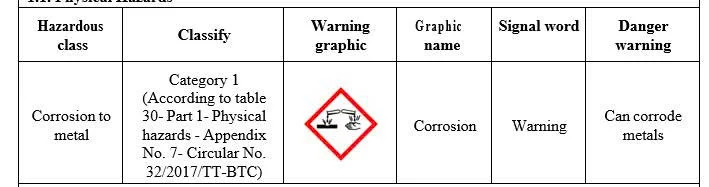
1.2 Health Hazards
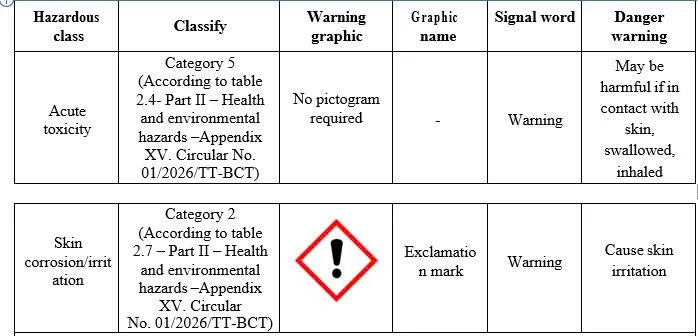
2. Hazard Statements
H317: May cause an allergic skin reaction.
3. Precautionary Statements
P264: Wash hands, arms, and other exposed areas thoroughly after handling.
P270: Do not eat, drink, or smoke when using this product.
P273: Avoid release to the environment.
P280: Wear protective gloves, protective clothing, and eye/face protection.
P301+P330+P331: IF SWALLOWED: Rinse mouth. Do NOT induce vomiting.
P303+P361+P353: IF ON SKIN (or hair): Take off immediately all contaminated clothing. Rinse skin with water/shower.
P305+P351+P338: IF IN EYES: Rinse cautiously with water for several minutes. Remove contact lenses, if present and easy to do.
P308+P311: IF exposed or concerned: Call a POISON CENTER or doctor/physician.
P363: Wash contaminated clothing before reuse.
P404: Store in a closed container.
P501: Dispose of contents/container in accordance with applicable regulations.
4. Other Hazards
No additional information available.
PART III: COMPOSITION / INFORMATION ON INGREDIENTS
Component | CAS No. | Chemical Formula | Concentration (% by weight) |
Poly Aluminium Chloride | 1327-41-9 | Alₙ(OH)ₘCl₃ₙ₋ₘ | 30% |
PART IV: FIRST-AID MEASURES
1. Description of First-Aid Measures According to Routes of Exposure
a) Eye Contact
In case of accidental contact with the eyes, immediately rinse thoroughly with clean water for at least 15 minutes.
Keep the eyelids open during rinsing.
Seek medical attention at the nearest medical facility.
b) Inhalation
Move the affected person to an area with fresh air.
Keep the person in a semi-reclining position.
Seek medical attention at the nearest medical facility.
c) Skin Contact
Immediately remove contaminated clothing and personal protective equipment.
Wash the affected skin thoroughly with plenty of water.
Seek medical attention at the nearest medical facility.
d) Ingestion
Do not induce vomiting unless instructed to do so by medical personnel.
Do not give anything by mouth to an unconscious person.
Loosen tight clothing, including the collar and belt.
Seek medical attention at the nearest medical facility.
2. Most Important Symptoms and Effects, Both Acute and Delayed
Eye contact: May cause eye redness, irritation, and swelling.
Skin contact: May cause skin irritation.
Inhalation: May cause throat irritation and a burning sensation in the throat.
Ingestion: May irritate the mucous membranes of the mouth, throat, esophagus, stomach, and gastrointestinal tract.
3. Indication of Immediate Medical Attention and Special Treatment Needed
Treat according to the instructions of a physician.
PART V: FIRE-FIGHTING MEASURES
Flammability Classification
PAC powder is classified as a non-flammable and non-explosive product.
Hazardous Combustion Products
Not applicable.
Extinguishing Media
Not applicable.
Unsuitable Extinguishing Media
Not applicable.
Special Fire-Fighting Procedures
Not applicable.
Protective Equipment and Precautions for Firefighters
Not applicable.
PART VI: ACCIDENTAL RELEASE MEASURES
1. Personal Precautions, Protective Equipment, and Emergency Procedures
Comply with all applicable local and international regulations.
Avoid contact with spilled or released material. Isolate the hazardous area and prevent unauthorized or unprotected personnel from entering the area.
Stop the release at its source if this can be done safely.
Use suitable absorbent materials to prevent environmental contamination.
Prevent the material from spreading into drains, sewers, waterways, or rivers by using sand, soil, or other suitable barriers.
2. Environmental Precautions
Release of PAC into the environment may cause pollution. Appropriate precautions must be taken to prevent the product from entering drains, sewers, waterways, or the surrounding environment.
Large quantities of PAC released into water may adversely affect aquatic ecosystems due to its acidifying effect.
3. Methods and Materials for Containment and Cleaning Up
Small quantities of spilled PAC may be neutralized using alkaline substances such as soda ash or hydrated lime.
After neutralization, absorb the material using suitable absorbents such as mineral soil, dry sand, or soil.
Collect the contaminated solid material, place it in suitable containers, and transfer it to a designated hazardous chemical waste storage area for proper disposal.
PART VII: HANDLING AND STORAGE
1. Precautions for Safe Handling
Avoid direct contact with skin and eyes.
Change protective clothing after completing work.
Appropriate corrosive-material warning signs should be displayed in areas where PAC is handled.
Follow established operating and sampling procedures when handling the product.
2. Conditions for Safe Storage
PAC should be stored in a dry, well-ventilated area.
For optimum storage conditions, maintain the storage temperature below 35°C.
Do not store PAC together with alkaline solutions.
Storage containers and equipment should not be made of metal.
Suitable materials include PP (polypropylene), glass, PVC, and ETFE.
PART VIII: EXPOSURE CONTROLS / PERSONAL PROTECTION
1. Control Parameters
No occupational exposure limits or biological exposure indices are currently available.
2. Appropriate Engineering Controls
Personal protective equipment should be selected according to the working environment and the concentration and quantity of chemicals being handled.
The chemical resistance of personal protective equipment should be verified with the equipment supplier.
Priority should be given to reputable personal protective equipment manufacturers, such as 3M.
3. Personal Protective Equipment
Eye protection: Wear safety goggles.
Body protection: Wear suitable protective clothing.
Hand protection: Wear chemical-resistant gloves.
Foot protection: Wear chemical-resistant safety shoes or boots.
Immediately replace clothing contaminated with chemicals.
Wash hands and face thoroughly after handling the chemical.
PART IX: PHYSICAL AND CHEMICAL PROPERTIES
Property | Information |
Physical state | Powder |
Boiling point (°C) | No data available |
Color | White to yellowish-white |
Melting point (°C) | No data available |
Odor | Pungent chlorine-like odor |
Flash point (°C) | No data available |
Vapor pressure (mmHg) at standard temperature and pressure | No data available |
Auto-ignition temperature (°C) | No data available |
Relative vapor density (Air = 1) | No data available |
Upper flammable/explosive limit (% by volume in air) | No data available |
Solubility in water | Soluble |
Lower flammable/explosive limit (% by volume in air) | No data available |
pH | 2.5–3.5 |
Evaporation rate | No data available |
Bulk density | > 0.68 |
Other properties | No data available |
PART X: STABILITY AND REACTIVITY
Reactivity
Reacts with incompatible materials.
Chemical Stability
Stable under normal conditions of use and storage.
The product may become unstable at temperatures above 40°C.
Possibility of Hazardous Reactions
Avoid contact with alkaline substances such as NH₃ and its solutions, NaOH, and KOH.
PAC may be corrosive to metals such as aluminum, copper, and brass.
Conditions to Avoid
No specific information available.
Incompatible Materials
Avoid contact with metals and light metals.
Hazardous Decomposition Products
Upon heating, the product may decompose to form hydrogen chloride (HCl) and aluminum oxide (Al₂O₃).
PART XI: TOXICOLOGICAL INFORMATION
1. Information on the Likely Routes of Exposure
Potential routes of exposure include:
- Skin contact
- Eye contact
- Ingestion
2. Symptoms Related to the Toxicological Characteristics of the Chemical
Eye contact: May cause eye redness and swelling. Severe exposure may result in serious eye injury and, in extreme cases, loss of vision.
Skin contact: May cause skin irritation.
Ingestion: May irritate the mucous membranes of the mouth, throat, esophagus, stomach, and gastrointestinal tract.
3. Acute, Delayed, and Chronic Effects of Short- and Long-Term Exposure
Eye contact: May cause eye redness and swelling. Severe exposure may result in serious eye injury and, in extreme cases, loss of vision.
Skin contact: May cause skin irritation.
Ingestion: May irritate the mucous membranes of the mouth, throat, esophagus, stomach, and gastrointestinal tract.
4. Toxicity Data
Component | Endpoint | Result | Route of Exposure | Test Organism |
Poly Aluminium Chloride | No data available | No data available | Dermal, oral | No data available |
PART XII: ECOLOGICAL INFORMATION
Ecotoxicity – Aquatic and Terrestrial
The compound may adversely affect aquatic ecosystems due to its acidifying effect when present in high concentrations in water.
Persistence and Degradability
No data available.
Bioaccumulative Potential
No data available.
Mobility in Soil
No data available.
Other Adverse Effects
No data available.
PART XIII: DISPOSAL CONSIDERATIONS
1. Waste Treatment Methods and Safe Disposal Information
PAC-contaminated wastewater: Treat by neutralizing the pH to a range of 6–9, in accordance with applicable Vietnamese standards and technical regulations.
PAC-contaminated packaging: Packaging contaminated with PAC should be handled in accordance with the requirements applicable to the chemical itself. Clean the chemical containers thoroughly and dispose of them in accordance with applicable regulations governing hazardous chemical waste.
2. Products Generated During Disposal and Treatment
The disposal process may generate salts and water that are not considered hazardous under normal conditions.
PART XIV: TRANSPORT INFORMATION
No specific transport information is provided in this section of the SDS.
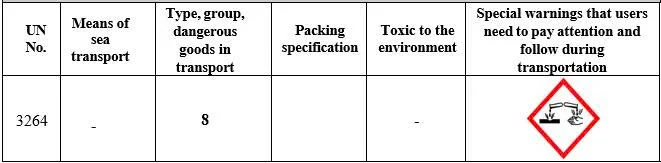
PART XV: REGULATORY INFORMATION
Applicable Laws and Regulations
The following legal and regulatory requirements shall be complied with:
- Law on Chemicals No. 69/2025/QH15, dated June 14, 2025.
- Decree No. 24/2026/ND-CP, dated January 17, 2026, issued by the Government, providing regulations on lists of chemicals falling within the scope of the Law on Chemicals.
- Decree No. 25/2026/ND-CP, dated January 17, 2026, issued by the Government, detailing and providing measures for the implementation of certain provisions of the Law on Chemicals concerning the development of the chemical industry and chemical safety and security.
- Decree No. 26/2026/ND-CP, dated January 17, 2026, issued by the Government, detailing and guiding the implementation of certain provisions of the Law on Chemicals concerning the management of chemical activities and hazardous chemicals in products and goods.
- Circular No. 01/2026/TT-BCT, dated January 17, 2026, providing detailed regulations and guidance on the implementation of certain provisions of the Law on Chemicals and Decree No. 26/2026/ND-CP concerning the management of chemical activities and hazardous chemicals in products and goods.
- Circular No. 02/2026/TT-BCT, dated January 17, 2026, providing certain measures for the implementation of the Law on Chemicals and Decree No. 25/2026/ND-CP concerning the development of the chemical industry and chemical safety and security.
- Decree No. 34/2024/ND-CP, dated March 31, 2024, issued by the Government, providing regulations on the list of dangerous goods transported by road motor vehicles and inland waterway vessels.
- Other applicable laws, regulations, standards, and technical requirements currently in force.
CONCLUSION
The information above represents the key contents provided in the Material Safety Data Sheet (MSDS) / Safety Data Sheet (SDS) for PAC (Poly Aluminium Chloride).
We hope this information provides useful guidance to help users better understand PAC and handle, store, and use the product safely and effectively.
For detailed information, technical support, or product consultation, please contact us: Tel/WhatsApp/Viber/Zalo: +84 342 597 726
Related Articles
Understanding Calcium Hypochlorite Through Its Material Safety Data Sheet (MSDS)
Calcium Hypochlorite, also known as chlorine powder or chlorin, has the chemical formula Ca(OCl)₂. ...
DONG A CHEMICAL SEEKS DISTRIBUTORS FOR CALCIUM HYPOCHLORITE (HS CODE 282810) IN SOUTHEAST ASIA
The rapid growth of water treatment, aquaculture, and textile industries across Southeast Asia is ...
Dong A Chemical Joint Stock Company Builds Vietnam’s First Large-Scale Chlorine Plant
With the goal of supplying customers with a full range of chlor-alkali chemicals, including ...
Top 7 Most Common Chemicals for Shrimp Pond Water Treatment
Hello, shrimp farmers! Shrimp farming is often described as a business of taking risks with nature. ...
TCCA 90 (Chlorine 90): The Solution for Water Safety
TCCA 90 not only eradicates pathogenic microorganisms but also prevents the growth of unwanted algae ...
Water Treatment Chemicals for Pangasius Farming: Uses, Benefits and Safety
Pangasius is one of the world’s most widely farmed freshwater fish species, particularly in ...