

Water Treatment Chemicals for Pangasius Farming: Uses, Benefits and Safety
Pangasius is one of the world’s most widely farmed freshwater fish species, particularly in intensive aquaculture systems across Southeast Asia. Its rapid growth, relatively efficient feed conversion and strong market demand make it an important commercial species.
However, high stocking density and intensive feeding can place considerable pressure on pond water quality. Uneaten feed, fish feces, suspended solids and decomposing organic matter may increase the microbial load, reduce dissolved oxygen and create favorable conditions for disease outbreaks.
Water treatment chemicals can support Pangasius health and farm productivity when they are selected and applied correctly. They may be used to disinfect pond infrastructure, prepare water before stocking, control certain external pathogens, oxidize excessive organic matter or manage problematic algae.
These products are not substitutes for good pond management. Incorrect chemical selection, excessive dosage or treatment under unsuitable water conditions can stress Pangasius, damage the gills, reduce beneficial microbial populations and contaminate the surrounding environment.
Why Water Quality Is Critical in Pangasius Farming
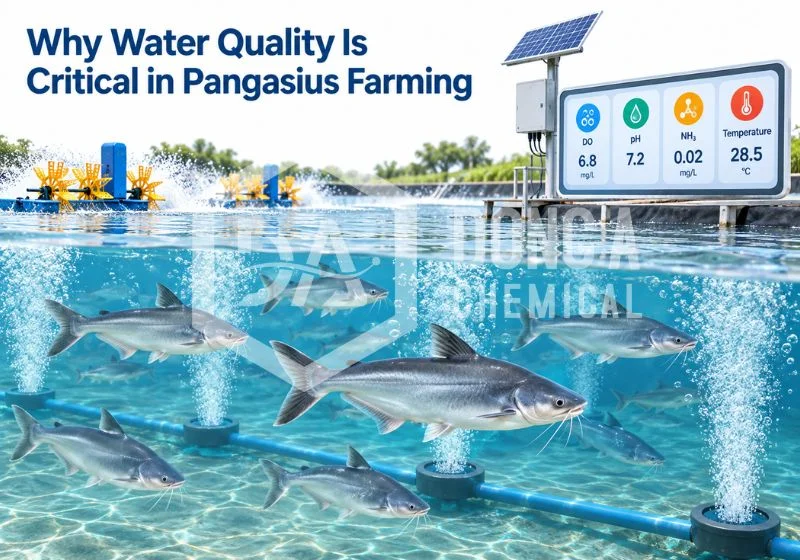
Pangasius can tolerate a wider range of environmental conditions than many freshwater fish species. Nevertheless, prolonged exposure to poor water quality can weaken the fish and reduce production performance.
Common water-quality problems in intensive Pangasius ponds include:
- Low dissolved oxygen
- High ammonia or nitrite concentrations
- Excessive organic matter
- Dense or unstable algal blooms
- High suspended-solid levels
- Elevated concentrations of pathogenic bacteria
- Sudden fluctuations in pH and temperature
- Accumulation of toxic gases in pond sediment
When fish are continuously exposed to these conditions, they may eat less, grow slowly and become more vulnerable to bacterial, fungal and parasitic infections.
Chemical treatment should therefore be considered part of an integrated water-quality management program that also includes aeration, sludge removal, responsible feeding, water exchange, biosecurity and routine monitoring.
Common Water Treatment Chemicals Used in Pangasius Aquaculture
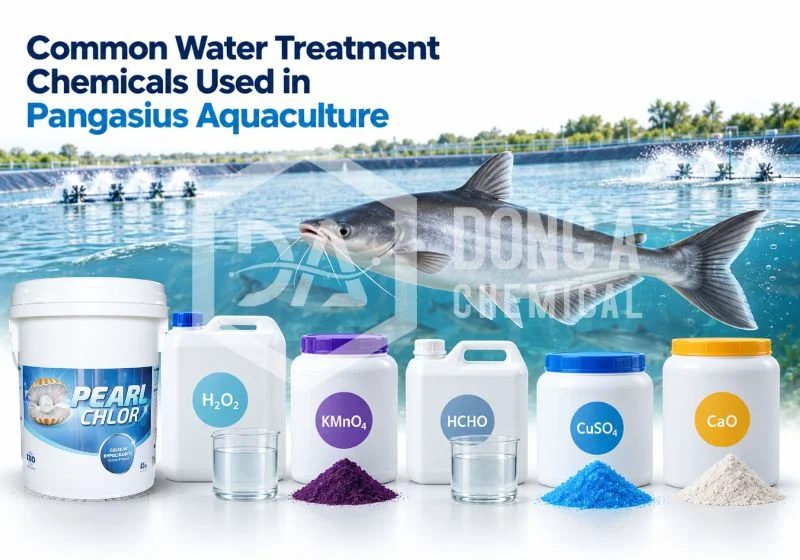
1. Chlorine-Based Disinfectants
Chlorine is a powerful oxidizing disinfectant used in many aquaculture operations. In Pangasius farming, chlorine-based products are generally more appropriate for:
- Disinfecting empty ponds before stocking
- Treating inlet water in a separate reservoir
- Sanitizing tanks, pipelines, nets and farming equipment
- Reducing pathogens in water before fish are introduced
Chlorine can inactivate a broad range of bacteria, viruses and other microorganisms. It also oxidizes part of the organic matter present in water.
However, residual chlorine is highly toxic to fish. It can irritate or damage the gills, disrupt respiration and cause mortality if treated water is transferred into a production pond before chlorine has been completely neutralized or dissipated.
The disinfecting performance of chlorine is influenced by pH, temperature, contact time, organic load and the product’s available-chlorine concentration. Water with a high organic load consumes chlorine rapidly, making treatment less predictable.
For this reason, chlorine should not be applied casually to ponds containing Pangasius. Farmers must verify that no harmful residual chlorine remains before stocking or transferring fish.
2. Calcium Hypochlorite
Calcium hypochlorite, commonly written as Ca(ClO)₂, is one of the most widely used solid chlorine-releasing compounds in aquaculture water treatment. Commercial products are available in several grades and may contain different percentages of available chlorine.
When dissolved in water, calcium hypochlorite releases hypochlorous acid and hypochlorite ions. Hypochlorous acid is the more effective disinfecting form, and its proportion depends strongly on water pH.
Calcium hypochlorite may be used for:
- Pond preparation between production cycles
- Disinfection of intake water
- Biosecurity treatment in storage or reservoir ponds
- Sanitization of aquaculture tools and surfaces
- Emergency disinfection under professional supervision
Its solid form makes calcium hypochlorite relatively convenient to transport and store. Nevertheless, it is a strong oxidizer and must be protected from moisture, heat, acids, fuels and other incompatible materials.
Calcium hypochlorite is a type of chlorine disinfectant rather than a completely separate treatment category. The actual dose must be calculated from the product’s available-chlorine content, water volume, organic demand and treatment objective.
3. Hydrogen Peroxide
Hydrogen peroxide, or H₂O₂, is an oxidizing agent used in aquaculture for specific water-treatment and fish-health applications. Depending on the authorized product and local regulations, it may help control certain external bacteria, fungi and parasites.
Hydrogen peroxide eventually decomposes into water and oxygen, which is one reason it is sometimes considered a comparatively low-residue oxidant. Nevertheless, concentrated hydrogen peroxide is hazardous, and an excessive treatment concentration can injure fish gills and skin.
Its effectiveness and safety depend on several factors:
- Fish species, size and health status
- Water temperature
- Treatment concentration
- Exposure time
- Organic-matter concentration
- Water hardness and overall chemistry
- Product formulation
Hydrogen peroxide should not be viewed as a routine solution for increasing dissolved oxygen in production ponds. Oxygen released during decomposition does not replace continuous mechanical aeration or correct the underlying causes of oxygen depletion.
Only registered aquaculture products should be used, according to their approved label and under aquatic-animal health guidance. Regulatory approval is species-, disease- and application-specific; for example, the FDA lists particular hydrogen peroxide and formalin products for defined aquaculture uses rather than granting unrestricted approval for all fish treatments. FDA – Approved Animal Drugs for Aquaculture Use
4. Potassium Permanganate
Potassium permanganate, or KMnO₄, is sometimes informally called the “purple chemical” because it produces a deep purple solution. It is a strong oxidizing agent—not cyanide.
In freshwater aquaculture, potassium permanganate may be used to:
- Oxidize part of the dissolved and suspended organic matter
- Reduce certain external bacterial populations
- Support the control of some external parasites
- Improve water appearance under appropriate conditions
The chemical demand of pond water can vary substantially. In water containing large amounts of organic matter, potassium permanganate may be consumed quickly before it achieves the intended treatment effect. Increasing the dose without measuring this demand can expose fish to excessive oxidation.
Overtreatment can damage gill tissue, increase respiratory stress and cause mortality. Its use should therefore be based on pond-water characteristics and professional assessment rather than on water color alone. Research also shows that potassium permanganate exposure can alter the external microbial community of fish, emphasizing that treatment affects more than the target organism. U.S. National Library of Medicine – Potassium Permanganate and Fish Microbiota
5. Formalin
Formalin is an aqueous solution containing formaldehyde and is used in some aquaculture systems to control selected external parasites and fungal infections. Its use is generally associated with diagnosed fish-health problems rather than routine pond-water conditioning.
Formalin requires particularly careful management because it can:
- Consume dissolved oxygen
- Irritate fish skin and gills
- Expose workers to hazardous vapors
- Become more toxic under unsuitable environmental conditions
- Create food-safety and regulatory concerns when misused
Formalin should never be used without adequate aeration, accurate water-volume calculations and a confirmed diagnosis. It must not be applied during periods of low dissolved oxygen or when fish are already severely stressed.
Only legally authorized aquaculture-grade products may be used. Industrial formaldehyde products are not automatically suitable for food-fish farming.
6. Copper Sulfate
Copper sulfate, or CuSO₄, has traditionally been used to manage certain algae and external parasites in freshwater ponds. Despite its potential effectiveness, the margin between a useful concentration and a toxic concentration can be narrow.
Copper toxicity is strongly influenced by water chemistry, particularly total alkalinity and hardness. In soft, low-alkalinity water, even a relatively small amount of copper may harm fish.
Possible consequences of improper use include:
- Gill damage
- Acute fish mortality
- Suppression of beneficial aquatic organisms
- Copper accumulation in pond sediment
- Rapid oxygen depletion following algal die-off
- Environmental contamination in discharged water
Copper sulfate should not be selected simply because pond water appears green. The type and density of algae, dissolved oxygen pattern, alkalinity and potential downstream impact must first be evaluated.
Comparison of Common Pangasius Water-Treatment Chemicals
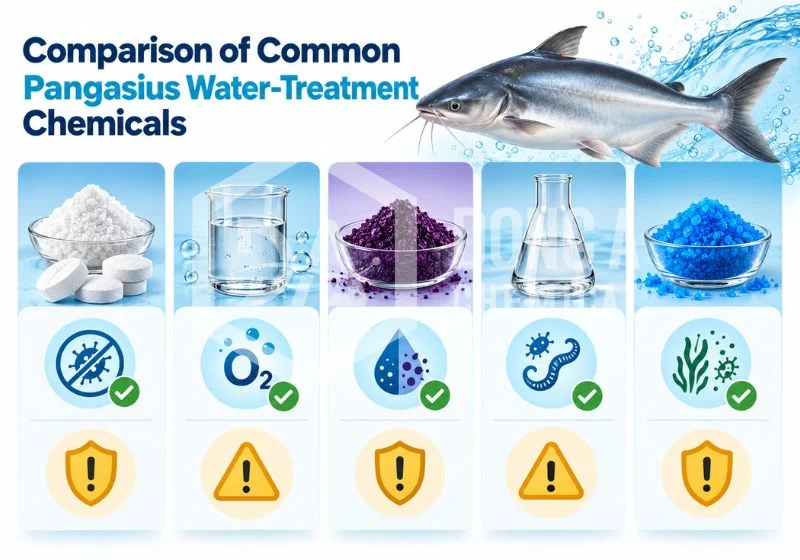
Chemical | Typical function | Main advantage | Key risk |
Calcium hypochlorite | Disinfection of empty ponds, equipment or intake water | Broad-spectrum oxidation and convenient solid form | Residual chlorine is highly toxic to fish |
Hydrogen peroxide | Selected external pathogen treatments and oxidation | Breaks down into water and oxygen | May injure gills at excessive concentrations |
Potassium permanganate | Oxidation of organic matter and control of selected external pathogens | Useful under properly assessed pond conditions | Efficacy and toxicity vary with organic demand |
Formalin | Control of specific external parasites and fungi | Effective for certain diagnosed conditions | Worker hazard, oxygen depletion and fish toxicity |
Copper sulfate | Algae and selected external parasite control | Rapid action in appropriate water chemistry | High toxicity in soft or low-alkalinity water |
Benefits of Responsible Chemical Treatment
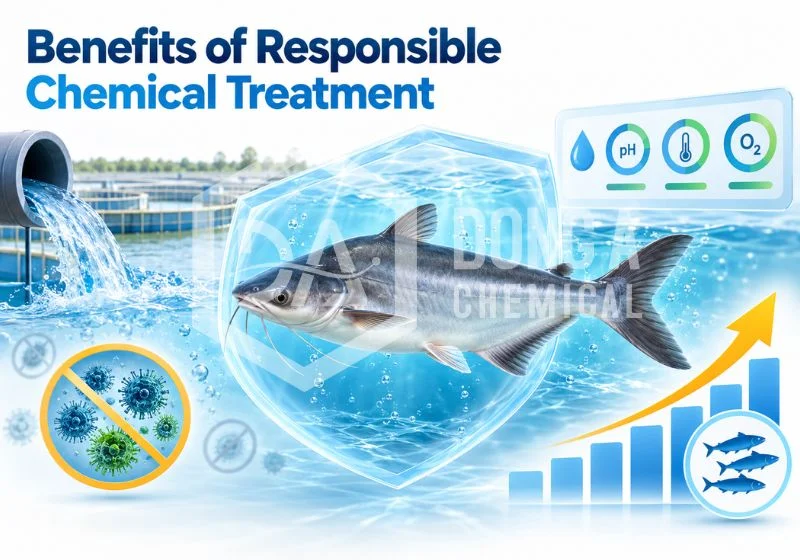
When supported by water testing, accurate calculations and a clearly defined treatment objective, aquaculture chemicals can provide several benefits.
Reduced pathogen pressure
Disinfection of ponds, equipment and intake water can reduce the transfer of harmful microorganisms between production cycles.
Better biosecurity
Treating water in a reservoir before it enters a production pond helps prevent pathogens from reaching the fish while reducing direct chemical exposure.
Improved control of organic matter
Selected oxidants may help reduce excessive organic loading. However, they do not replace sludge management, correct feeding practices or adequate water circulation.
Support during diagnosed health problems
Certain approved treatments may assist in controlling external parasites, fungi or bacteria when applied following a reliable diagnosis.
More stable production performance
By reducing avoidable water-quality stress, farms may achieve better feeding response, survival and growth consistency. These benefits depend on addressing the root cause rather than relying repeatedly on chemical intervention.
Potential Risks to Fish, Workers and the Environment
Aquaculture chemicals can cause serious harm when they are used without adequate technical control.
Fish toxicity
Most oxidizing chemicals can damage the skin and gills at excessive concentrations. Young, weak or diseased fish may be more sensitive than healthy fish.
Dissolved-oxygen depletion
Some treatments directly consume oxygen or kill large quantities of algae and microorganisms. Their subsequent decomposition may cause a sudden decline in dissolved oxygen.
Disruption of the pond ecosystem
Broad-spectrum disinfectants may reduce beneficial microorganisms involved in organic-matter degradation and nutrient cycling.
Chemical residues and food safety
Unapproved products or incorrect treatments may create residue concerns and affect the marketability of harvested Pangasius.
Occupational hazards
Concentrated chlorine, hydrogen peroxide and formalin can cause serious injury through skin contact, eye exposure or inhalation. Appropriate personal protective equipment and chemical-handling procedures are essential.
Environmental pollution
Discharging chemically treated water without proper control may harm natural aquatic ecosystems and violate local environmental regulations.
How to Select the Right Treatment
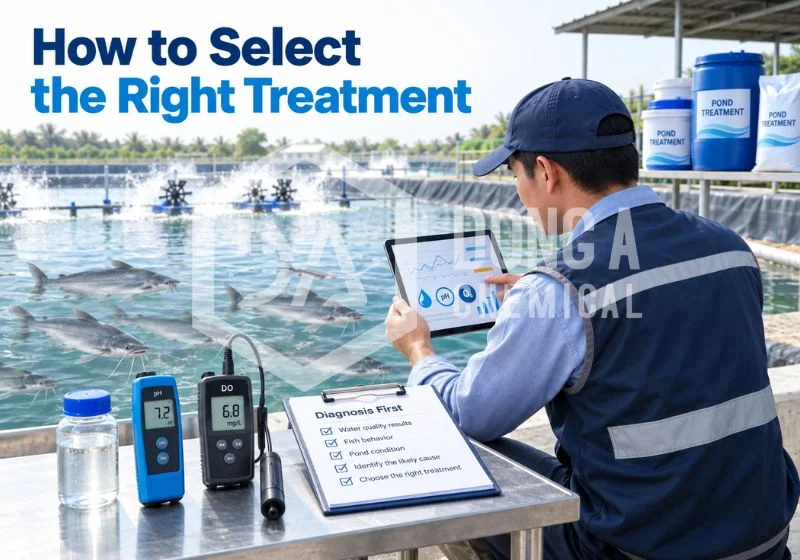
Before using any chemical in a Pangasius pond, farm managers should answer five essential questions:
- What is the specific problem being treated?
- Has the problem been confirmed through water testing or fish-health diagnosis?
- Is the product legally approved for the intended aquaculture use?
- How will pH, alkalinity, temperature, organic load and dissolved oxygen affect treatment safety?
- How will the farm monitor the fish and respond if oxygen levels fall or signs of stress appear?
At a minimum, the following parameters should be checked before treatment:
- Pond volume
- Water temperature
- pH
- Dissolved oxygen
- Total alkalinity and hardness
- Ammonia and nitrite
- Organic load or oxidant demand
- Fish biomass, age and health status
The chemical dose should be calculated from the active-ingredient concentration—not simply from the total weight or volume of the commercial product.
Best Practices for Safe Chemical Application
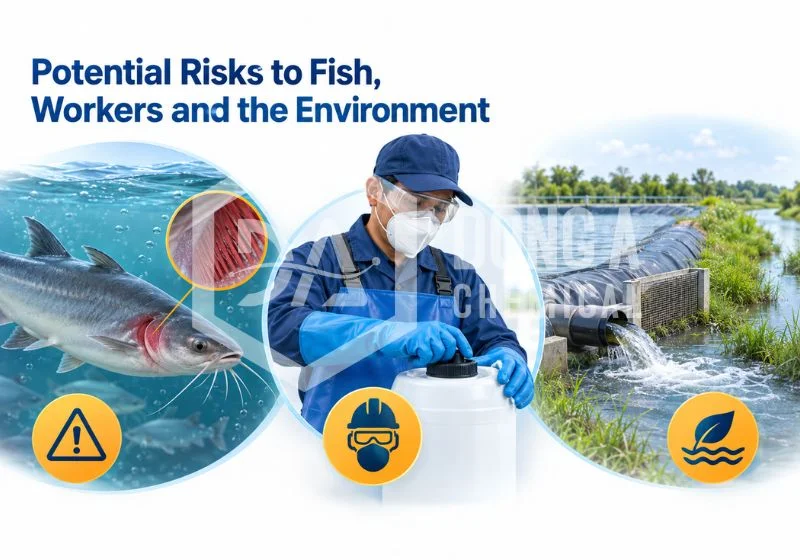
To reduce treatment risks, Pangasius farmers should:
- Identify the cause of the problem before selecting a chemical
- Use products registered for aquaculture and food-fish production
- Read the label, safety data sheet and manufacturer’s technical guidance
- Calculate pond volume and active ingredient accurately
- Perform a small-scale tolerance test when professionally recommended
- Maintain strong aeration throughout treatments that may affect oxygen
- Monitor fish behavior and dissolved oxygen during and after application
- Never mix oxidizers with acids, fuels or incompatible chemicals
- Store products in a cool, dry and ventilated area
- Record the product, batch number, dose, pond, date and treatment result
- Observe all withdrawal periods and local regulations
- Seek support from an aquatic veterinarian or aquaculture specialist when disease is suspected
Chemical Treatment Is Not a Substitute for Pond Management
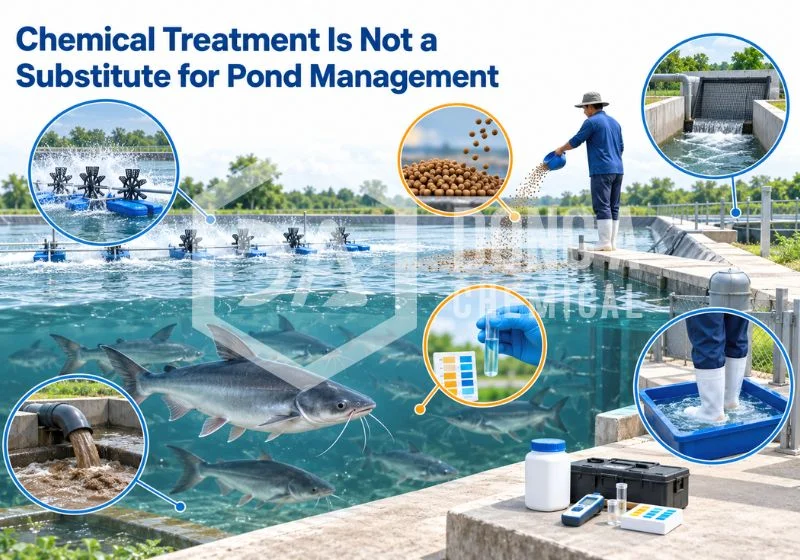
Frequent chemical use often indicates that the underlying farming system requires improvement.
Long-term Pangasius health depends primarily on:
- Appropriate stocking density
- High-quality feed and controlled feeding
- Effective aeration
- Regular sludge removal
- Stable pH and alkalinity
- Controlled ammonia and nitrite
- Biosecure intake water
- Proper disposal of dead or diseased fish
- Routine fish-health surveillance
- Responsible water exchange and effluent treatment
Chemical intervention should be targeted, measurable and temporary. Preventive farm management remains the most sustainable way to maintain water quality and improve Pangasius production.
Frequently Asked Questions
1. What is the best chemical for treating Pangasius pond water?
There is no single best chemical for every pond. Product selection depends on the treatment objective, fish-health status, water chemistry, organic load and local regulations. A chemical should only be chosen after the problem has been identified.
2. Can calcium hypochlorite be applied directly to a pond containing Pangasius?
Direct application carries a significant risk because residual chlorine is toxic to fish. Calcium hypochlorite is generally better suited to empty-pond disinfection, equipment sanitation or treatment of intake water in a separate reservoir. Any use around live fish requires professional control and verification of residual chlorine.
3. Is potassium permanganate the same as cyanide?
No. Potassium permanganate is KMnO₄, a purple oxidizing compound. Cyanide compounds are chemically different and highly toxic. The two terms must never be used interchangeably.
4. Can hydrogen peroxide replace pond aeration?
No. Although hydrogen peroxide decomposes into water and oxygen, it is not a substitute for mechanical aeration or proper dissolved-oxygen management.
5. Why is copper sulfate risky in fish ponds?
Copper toxicity increases in water with low alkalinity or hardness. It may also kill algae rapidly, leading to oxygen depletion as the dead biomass decomposes.
6. Should chemicals be applied whenever fish show signs of disease?
No. Similar symptoms may result from bacterial infection, parasites, low dissolved oxygen, ammonia toxicity or other environmental stressors. Applying the wrong treatment may worsen the condition and delay effective intervention.
Conclusion
Water treatment chemicals can support disease control, biosecurity and water-quality management in Pangasius farming. Calcium hypochlorite, hydrogen peroxide, potassium permanganate, formalin and copper sulfate each have specific functions, but they also present distinct risks.
Successful treatment requires more than choosing a chemical. Farmers must correctly identify the problem, evaluate pond-water conditions, calculate the active ingredient, follow applicable regulations and monitor fish closely throughout the treatment process.
Used responsibly, chemicals can be valuable management tools. Used without diagnosis or technical control, they may reduce fish survival, increase production costs and damage the surrounding environment. For sustainable Pangasius production, chemical treatment should always complement—not replace—sound water management, effective biosecurity and preventive fish-health practices.
Contact Us
Nguyen Bich Hanh – Hanah (Ms.)- International Sales Executive
Email: export@dongachem.vn; hanh.nguyen@dongachem.vn
Tel / WhatsApp / Viber / Zalo: +84 342 597 726
Dong A Chemical – Reliable Chemical Solutions for Water Treatment and Aquaculture.
Related Articles
TCCA 90 (Chlorine 90): The Solution for Water Safety
TCCA 90 not only eradicates pathogenic microorganisms but also prevents the growth of unwanted algae ...
Top 7 Most Common Chemicals for Shrimp Pond Water Treatment
Hello, shrimp farmers! Shrimp farming is often described as a business of taking risks with nature. ...
Understanding PAC Through Its Safety Data Sheet (SDS)
PAC (Poly Aluminium Chloride), also known as aluminum polychloride, with the chemical formula ...
Integrated Disease Prevention in Shrimp Farming: Effective Water Treatment and Pond Management Protocols
In intensive and super-intensive shrimp farming, disease outbreaks rarely result from a single ...
How to Mix Chlorine to Disinfect a Home Swimming Pool
Chlorine is widely used to disinfect and treat wastewater, drinking water and swimming pool water. ...
Calcium Hypochlorite Price in September 2026: HS Code 28281000
How much does calcium hypochlorite cost per kilogram or per drum? The answer depends on its ...